Shopify
AI Shopping Agents Just Got a Front Door: What the Personal Agent Protocol Means for Your Store
For the last couple of years, AI shopping agents have been doing something a little awkward. They open your store like a person would, click around, read product pages, and try to guess how your checkout works. Sometimes it goes fine. Often it doesn’t. And from your side as a store owner, you usually have no idea whether a real customer or a bot acting for that customer just visited.
That is starting to change. On October 9, 2026, Sierra published the first public draft of the Personal Agent Protocol, a new open standard it is building with Meta. Shopify, Stripe and Walmart were part of it from day one, and with the draft came 35 more design partners, including OpenAI, Visa, Mastercard, PayPal, Adyen, Klaviyo, Cloudflare, Target, Nordstrom and Gap. When names like that sign on in the same week, it is worth paying attention, especially if you sell online.
Here is what it is, how it works, and what it means for your Shopify or WooCommerce store.
What the Personal Agent Protocol actually is
Think of it as a proper front door for AI agents. Instead of an agent pretending to be a human and scraping its way through your site, the protocol gives it a standard way to say “I’m an agent working for this customer,” sign in with the customer’s permission, and only do what it has been allowed to do.
Sierra announced the idea on October 6 and shared the draft three days later. A formal version 0.1 of the specification is expected later this month. The draft is public at personalagentprotocol.org, and Sierra says it will run design workshops and publish a reference implementation for developers over the next month.
How it works, in plain terms
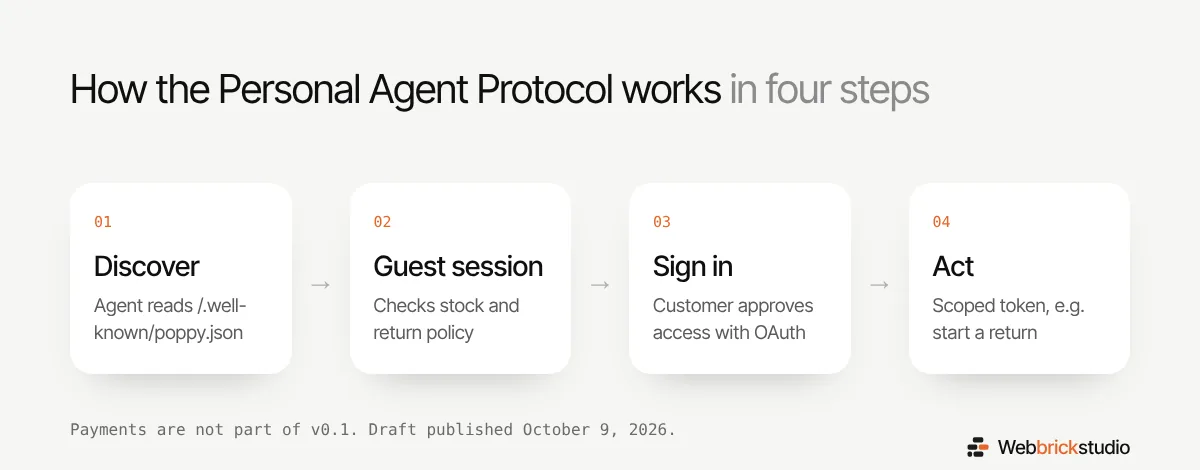
The draft is built from five pieces. None of them are exotic. They lean on tools the web already uses, like OAuth, JSON Web Tokens, HTTPS, OpenAPI and MCP.
- Discovery. Your business publishes a small file at a standard address on your domain,
/.well-known/poppy.json. It tells agents how to work with you, how customers sign in and what an agent is allowed to do. - Sessions. The agent opens a session for its customer and identifies itself, so you know an agent is acting on someone’s behalf. A session can start as a guest, which is enough to check stock or read your returns policy.
- Sign in. When a task needs account access, the customer signs in on your own page using OAuth. The agent then gets a token that only covers what the customer approved.
- One session across channels. The same token works on your website, your APIs and your own chatbot, so a question asked before login and an order change made after login count as one visit.
- Getting the job done. You decide how agents reach you: through your normal website, through APIs, or through your own agent.
Sierra gives a simple example of the limits in action. An agent might be allowed to start a return, but not to change the payment details on the account. That kind of control is exactly what has been missing.
Why this matters for store owners
The biggest shift is visibility. Right now most stores cannot tell agent traffic apart from human traffic. Under this protocol, you would know when an agent is acting for a customer and you would set the rules for what it can do. That is good for fraud prevention, for customer service and for plain old analytics.
It also changes where your customers might come from. If people start asking an assistant to “reorder my usual coffee” or “find me a black tote under $60 with free returns,” the stores that agents can understand cleanly will have an edge over the ones they have to guess their way through. That is the same lesson we learned with search engines years ago, just with a new kind of visitor.
What it does not do yet
It is important to keep expectations realistic. This is an early draft, not a finished standard.
- Payments are not in the first version. Letting an agent complete a purchase without sharing card details is on the roadmap, along with push notifications and finer permissions per action, but it is not in v0.1.
- It is not the only protocol. Visa already runs its own Trusted Agent Protocol, and both Shopify and Stripe are involved in that one too. It is too early to say which approach wins, or whether they end up working side by side.
- Europe may move slower. Payment rules there are written around a person approving a payment, and most early partners are US companies.
What you should do now
You do not need to rebuild anything this week. But a few sensible steps will put your store in a good position whichever standard takes off.
- Clean up your product data. Clear titles, real descriptions, correct prices, stock levels and variants. Agents rely on structured, accurate data far more than on nice photos.
- Add proper schema markup. Product, Offer, Review and FAQ schema help both Google and AI agents understand your pages. If your theme skips this, it is worth fixing.
- Make your policies easy to read. Shipping, returns and warranty pages should be plain text pages, not images or buried in popups. Guest sessions will check these first.
- Keep your platform current. Shopify is a founding partner, so expect support to arrive through the platform. On WooCommerce, keep WordPress, WooCommerce and your payment plugins up to date so new integrations are easy to add later.
- Watch your logs. Start noticing agent and bot traffic in your analytics now, so you have a baseline before it grows.
The bottom line
AI agents shopping on behalf of real people is no longer a far off idea. The Personal Agent Protocol is an attempt to make that safe and visible for both sides, and the list of companies behind it suggests it will not quietly disappear. For most stores the smart move today is not to chase the spec, but to make sure your store is fast, well structured and easy for any visitor to understand, human or not.
If you want a second pair of eyes on how ready your Shopify or WordPress store is for this shift, get in touch with Web Brick Studio. We are happy to take a look.