Web Design
Google’s September 2026 Spam Update Is Done: How to Check If Your Site Was Hit
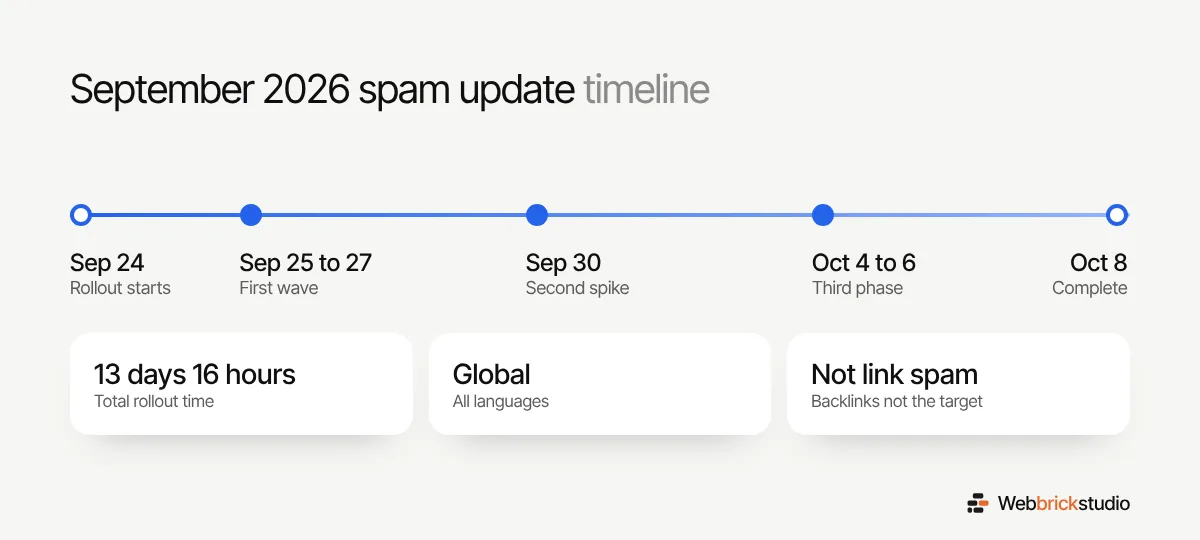
Google has finished rolling out its September 2026 spam update. It started on September 24 and was confirmed complete early on October 8, after 13 days and 16 hours. If your traffic did something strange over the last two weeks, this is probably why you are reading this.
This one was a little different from what we are used to, so it is worth slowing down before you start changing things on your site. Here is what we know, what we do not know, and how to check whether your website was affected.
Why this spam update felt different
Most recent Google spam updates finished in about two days. This one was announced as taking up to two weeks, and it really did. It applied globally and to every language.
Because it ran so long, it did not hit everyone at the same time. SEO trackers saw it come in waves:
- September 25 to 27: the first round of ranking drops.
- September 30: a second spike in volatility.
- October 4 to 6: a third phase before Google called it done.
So if your rankings looked fine for a week and then dropped, that does not mean you were safe. Different sites felt it on different days.
What Google targeted
Google has been fairly quiet on the details. What it has said is that the update improves its automated spam detection and goes after sites that break some of its search spam policies. It also said two clear things it is not:
- It is not a link spam update, so a sudden drop is unlikely to be about your backlinks.
- It does not cover every spam policy, only some of them.
Google has not said which policies were in focus or how many searches were affected. Site owners on forums have reported drops in both Search and Discover traffic, and some have pointed at thin or poorly translated AI generated articles. Those are anecdotes, not confirmed findings, but they line up with what Google’s spam policies have been pushing against for a while: content made at scale to rank rather than to help anyone.
How to check if your site was hit
Do not judge this from a third party rank tracker alone. They swing around a lot during updates. Use your own data first.
- Open Google Search Console. Go to the Performance report and compare clicks and impressions from September 24 to October 8 against the two weeks before.
- Look for a lasting drop, not a dip. A real hit shows up as a decline that holds for several days in both impressions and clicks. A one day wobble is usually just noise.
- Check which pages fell. Filter by page. If the losses are concentrated on a group of similar pages, such as location pages, auto generated posts or old thin content, that is your clue.
- Check Manual Actions. Algorithmic updates do not send a notice, but it takes ten seconds to rule out a manual penalty under Security and Manual Actions.
- Compare the timing with the phases. If your drop lines up with September 25 to 27, September 30 or October 4 to 6, the update is the likely cause. If it started on a different day, look for something else first, such as a site change, a broken redirect or tracking problem.
What to do if your traffic dropped
Here is the honest part: there is no quick fix. Google’s own guidance is to review its spam policies and make sure your site follows them. Its systems then need time, often months, to notice the site has improved. Google has also said it will refresh this update from time to time, so recovery tends to show up with those refreshes.
In practice, that means:
- Remove or improve thin pages. If you have pages that exist only to catch a keyword, merge them, rewrite them properly or remove them.
- Be careful with mass produced AI content. AI can help you write, but publishing large amounts of unedited, generic articles is exactly what spam systems are built to spot. Every page should have a clear reason to exist and something real to say.
- Do not rent out your domain’s reputation. Third party content hosted on your site to borrow your rankings is a known risk area.
- Fix the basics. A fast site, clean headings, accurate schema and pages written for people do not guarantee recovery, but they make every future update less scary.
What not to do
Do not panic and rebuild your whole site, change every title tag or disavow half your backlinks. This was not a link update, and big random changes make it harder to see what is actually working. Make focused improvements, document what you changed and when, and give it time.
The takeaway
The September 2026 spam update was longer and patchier than usual, but the message behind it is not new. Google keeps getting better at spotting content made only for rankings. Sites built around real expertise, useful pages and a good experience usually come through these updates fine, and often gain when weaker competitors drop.
If your WordPress or Shopify site lost traffic during the update and you are not sure why, talk to Web Brick Studio. We will go through your Search Console data with you and tell you plainly what we find.